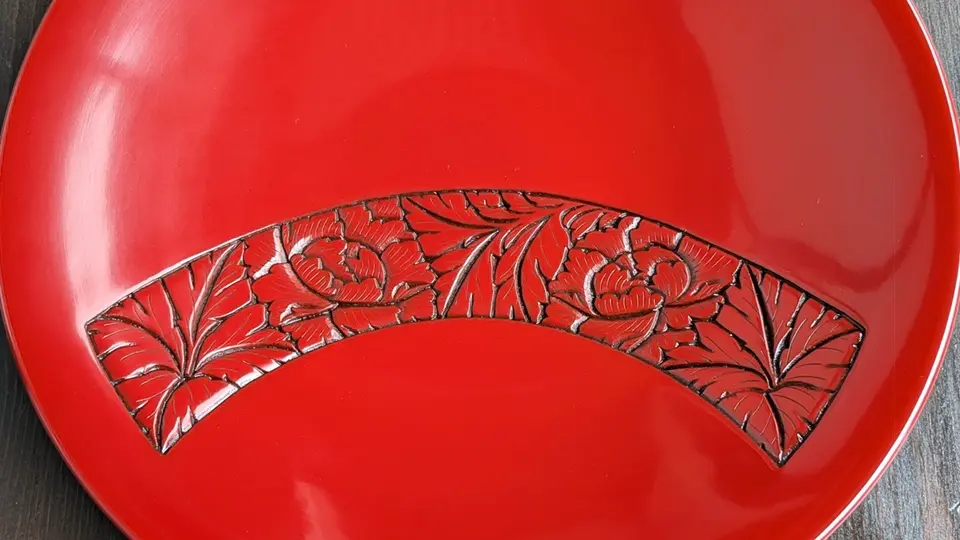
Murakami Kibori Tsuishu is a traditional form of wood-carved lacquerware from Murakami, Niigata, Japan. Its distinctive character comes from combining detailed wood carving with repeated applications of natural urushi lacquer.
The word tsuishu, however, does not always refer to the same technique. In its original sense, tsuishu is a form of carved lacquer in which many layers of red lacquer are built up and then carved. Murakami Kibori Tsuishu is made differently: the design is carved into the wooden base first, and lacquer is applied afterward.
This guide begins by explaining what tsuishu means and how the term is used in Japan. It then explores Murakami Kibori Tsuishu in depth, including its history, official recognition, production process, six traditional techniques, motifs and jimon patterns, everyday use, and care.
This page is the English-language counterpart to our Japanese guide to Murakami Kibori Tsuishu.
Japanese version: 【村上木彫堆朱】堆朱とは|意味・歴史・種類の基本を丁寧に解説
Table of Contents
- What Is Tsuishu?
- What Is Murakami Kibori Tsuishu?
- History and Official Recognition of Murakami Kibori Tsuishu
- How Murakami Kibori Tsuishu Is Made
- Six Traditional Techniques of Murakami Kibori Tsuishu
- Motifs and Jimon Patterns in Murakami Kibori Tsuishu
- Using and Caring for Murakami Kibori Tsuishu
- Where to See Murakami Kibori Tsuishu
- Frequently Asked Questions
- Summary
- References and Further Reading
What Is Tsuishu?
Tsuishu (堆朱) is a term used for a type of lacquer craft and for objects made using that tradition.
In its original sense, tsuishu is a form of carved lacquer in which many layers of red lacquer are applied to build up sufficient thickness, and decorative designs are then carved directly into the hardened lacquer layers.
The Japanese character 堆 (tsui) means “to pile up” or “to accumulate,” while 朱 (shu) refers to vermilion or red. The name therefore reflects the basic idea of building up layers of red lacquer and carving decorative designs into those layers.
This distinction is important when considering Murakami Kibori Tsuishu, because not everything called tsuishu in Japan is made by carving thick layers of lacquer.
Origins and History of Tsuishu
Tsuishu developed as one of the carved-lacquer techniques of Chinese lacquer craftsmanship.
Chinese lacquer craft has a very long history. Lacquer was used not only to protect objects but also as a material for highly sophisticated decoration. Over time, a wide range of techniques developed, including coating, painting, inlaying shell, applying gold, and carving the lacquer itself.
Among these techniques was chōshitsu (彫漆), or carved lacquer, in which many layers of lacquer are applied to build up sufficient thickness and decorative designs are then carved into the hardened lacquer layers. When red lacquer is built up and carved, the technique is known in Japanese as Tsuishu (堆朱); black lacquer produces Tsuikoku (堆黒), and yellow lacquer Tsuio (堆黄).
In Tsuishu, motifs such as flowers and birds, dragons, phoenixes, human figures, and landscapes are carved into multiple layers of red lacquer. Because the process requires both repeated lacquer application and highly skilled carving of the hardened lacquer layers, it developed into a highly decorative form of lacquer art.
Carved lacquer flourished in China during the Song dynasty (960–1279) and Yuan dynasty (1271–1368). During the Yuan dynasty in particular, works were produced with substantial lacquer layers and boldly carved designs. Surviving works from the Song and Yuan periods demonstrate the high level reached by Chinese carved lacquer during this era.
Chinese carved lacquer was later introduced to Japan and was highly prized as Tsuishu and Tsuikoku. During the Kamakura period (1185–1333) in particular, such works were brought to Japan in connection with the spread of Zen Buddhist culture and were treasured in temples in forms such as incense trays and incense containers. Over time, Japanese craftspeople absorbed the techniques and ideas of Chinese carved lacquer and combined them with local traditions of woodworking, lacquer coating, and carving.
Tsuishu, Carved Lacquer, and Cinnabar Lacquer
In the broader history of decorative arts, Tsuishu is recognized as one of the highly developed forms of Chinese carved lacquer.
Lacquer culture developed primarily in East Asia, including China, Japan, and the Korean Peninsula. Urushi lacquer has served not only as a protective coating for objects but also as an artistic material valued for its lustre, color, durability, and decorative possibilities.
What distinguishes Tsuishu is that the lacquer itself is carved. Rather than simply decorating the surface of wood or metal, craftspeople apply many layers of lacquer to create sufficient thickness and then carve designs into those accumulated layers. The technique therefore requires substantial amounts of material, time, and highly developed craftsmanship.
In English-language museums and scholarship, Chinese examples of this technique are commonly described as “Chinese carved lacquer” or “carved red lacquer.” The term “cinnabar lacquer” is also widely used, particularly for red Chinese carved lacquer. The name refers to cinnabar, a red mineral pigment traditionally used to color the lacquer. The Metropolitan Museum of Art, for example, notes that carved lacquer is predominantly red and is often called “cinnabar lacquer” because powdered cinnabar was used as its principal red colorant.
Chinese Tsuishu survives in many forms, including dishes, trays, boxes, and incense containers. Its carved decoration includes flowers and birds, dragons, phoenixes, human figures, and landscapes, reflecting both the artistic traditions and aesthetic preferences of different periods in Chinese history.
In Japan, however, the influence of Chinese Tsuishu and other forms of carved lacquer led to several different developments. Some Japanese traditions continued to carve directly into built-up lacquer layers, while others developed methods in which the wooden base was carved first and lacquer was applied over the carving.
Murakami Kibori Tsuishu belongs principally to this latter, wood-carved lacquerware tradition. Understanding this distinction is important because the same Japanese word tsuishu may refer to crafts with significantly different structures and production methods.
Crafts Known as “Tsuishu” in Japan
In Japan, distinctive lacquerware traditions developed in different regions under the influence of Chinese lacquer craft and carved lacquer.
An important point to understand is that not every craft called tsuishu in Japan is made in the same way as traditional Chinese Tsuishu, in which thick layers of lacquer are built up and the lacquer itself is carved.
For ease of understanding, Japanese crafts known as tsuishu can be broadly and informally grouped into several types.
The first is carved-lacquer Tsuishu, in which many layers of lacquer are built up and designs are carved directly into the lacquer layers. This approach is closest in principle to traditional Chinese Tsuishu, with the carving of the lacquer itself forming the central technique.
The second is wood-carved Tsuishu, in which designs are carved into the wooden base first and red lacquer is then applied over the carving. Murakami Kibori Tsuishu, handed down in Murakami, Niigata, is representative of this approach. Its characteristic expression comes from combining carving of the wooden base with subsequent applications of lacquer, rather than carving deeply into thick, accumulated lacquer layers.
A third group includes regional traditions in which production methods developed in their own distinctive ways. One example is Sendai Tsuishu (仙台堆朱, Sendai Tsuishu). Its development was historically connected with Murakami Tsuishu, while a mold-pressing method was introduced to make the carving process more efficient.
In this way, crafts called tsuishu in Japan may involve carving the lacquer layers themselves, carving the wooden base before applying lacquer, or production methods that developed independently within particular regions. Although they share the name tsuishu, their methods, appearance, and surface qualities can differ considerably.
However, these differences are not always easy to identify from appearance alone. Once a lacquered object is fully finished, it may be difficult to determine simply from its surface whether the design was carved into accumulated lacquer layers or carved into the wooden base before lacquering.
For this reason, when identifying the type or production area of a particular piece, it is important not to rely on appearance alone. Information such as the name of the craft, production area, inscriptions on the box, accompanying documentation, and place of purchase can provide important clues.
If a judgment about authenticity or value is required, it is safer to consult a specialist lacquerware dealer, an association in the production area, or another professional with relevant expertise.
This guide now turns to Murakami Kibori Tsuishu, the lacquer craft handed down in Murakami, Niigata.
What Is Murakami Kibori Tsuishu?
Murakami Kibori Tsuishu (村上木彫堆朱, Murakami Kibori Tsuishu) is a traditional lacquer craft that has been handed down in Murakami, Niigata, Japan. The name Murakami Tsuishu (村上堆朱, Murakami Tsuishu) is also widely used and has appeared historically in records and in Japan’s cultural property system.
Murakami Kibori Tsuishu does not refer only to Tsuishu, its best-known technique. Today, the name encompasses six traditional lacquer techniques practiced in Murakami: Tsuishu (堆朱), Tsuikoku (堆黒), Shudame-nuri (朱溜塗), Iro-urushi-nuri (色漆塗), Kinma-nuri (金磨塗), and Sansai-bori (三彩彫).
One commonly cited starting point in the development of Murakami’s Tsuishu and Tsuikoku traditions is the introduction of techniques learned in Edo by samurai of the Murakami Domain during the Edo period. These techniques were brought back to the castle town, where local craftspeople gradually refined distinctive methods combining wood carving and lacquerwork. By the modern period, Murakami Tsuishu had become established as one of the region’s representative crafts.
Its technical and cultural value has also received official recognition. In 1955, “Murakami Tsuishu” was designated an Intangible Cultural Property by Niigata Prefecture. In the same year, it was selected at the national level as an intangible cultural property for which documentation and other preservation measures should be undertaken. The national selection was made on March 19, 1955. In 1976, under a system separate from cultural property designation, Murakami Kibori Tsuishu was designated as a Traditional Craft of Japan.
One of the defining features of Murakami Kibori Tsuishu is the close relationship between carving and lacquerwork. In its characteristic wood-carved techniques, designs are first carved into the wooden base, and natural urushi lacquer is then applied in repeated layers in a way that preserves and enhances the carving.
The word tsuishu originally refers to a technique developed in China in which many layers of lacquer are built up to considerable thickness and designs are carved directly into those lacquer layers. In the characteristic wood-carved techniques of Murakami, by contrast, the wooden base is carved first and lacquer is applied afterward. The two can produce similarly sculptural effects, but their structures and production methods are fundamentally different.
The resulting combination of three-dimensional wood carving with the subdued color and distinctive texture of urushi is one of the defining qualities of Murakami Kibori Tsuishu.
Newly finished pieces often have a restrained, matte appearance. With long use, the surface gradually develops a natural lustre and the colors gain greater depth. This change in appearance over time is another characteristic of Murakami Kibori Tsuishu.
A wide variety of objects are made in this tradition, including trays, vessels, tea utensils, chopsticks, and personal accessories. Murakami Kibori Tsuishu is therefore both a craft appreciated for its carving and lacquerwork and a form of lacquerware that has long been used in everyday life.
Murakami Kibori Tsuishu vs. Chinese Carved Lacquer
The shared word tsuishu can cause confusion because the characteristic techniques of Murakami Kibori Tsuishu differ fundamentally from traditional Chinese carved lacquer.
| Murakami Kibori Tsuishu | Traditional Chinese Carved Lacquer | |
|---|---|---|
| What is primarily carved? | The wooden base | The built-up lacquer layers |
| When is the main carving done? | Before the lacquer is applied | After many lacquer layers have been built up |
| Basic structure | Carved wood covered with urushi lacquer | Thick lacquer layers carved to form the design |
| Characteristic expression | Wood carving and lacquerwork work together | The carved lacquer layers themselves create the relief |
| English description used in this guide | wood-carved lacquerware | carved lacquer / Chinese carved lacquer |
For this reason, this guide uses wood-carved lacquerware as a descriptive English term for Murakami Kibori Tsuishu. This wording helps distinguish the characteristic Murakami approach from carved lacquer, in which the accumulated lacquer layers themselves are the principal material being carved.
History and Official Recognition of Murakami Kibori Tsuishu
Historical Overview
Urushi trees have long grown in Murakami and the surrounding area, where a culture of using lacquer developed over many centuries. Lacquered objects have been excavated from archaeological sites dating to the Jōmon period (ca. 14,000–300 BCE), while written records from the Heian period (794–1185) show that lacquer was treated as an important product of Echigo Province, which included present-day Niigata Prefecture.
During the Muromachi period (1336–1573), temple construction and related building activity helped develop the skills of local craftspeople engaged in woodworking and carving. In the Edo period (1603–1868), continued temple construction and the encouragement of crafts by the Murakami Domain further strengthened the technical and industrial foundations of woodworking, carving, and lacquerwork in the region.
Against this background, techniques for Tsuishu and Tsuikoku learned in Edo by samurai of the Murakami Domain are said to have been introduced to the castle town during the Edo period. Rather than simply reproducing these techniques, Murakami craftspeople developed distinctive methods that combined carving of the wooden base with subsequent applications of lacquer. By the modern period, this tradition had become established as one of Murakami’s representative crafts.
Its technical and cultural value continued to receive official recognition. In 1955, “Murakami Tsuishu” was designated an Intangible Cultural Property by Niigata Prefecture and was also selected at the national level as an intangible cultural property for which documentation and other preservation measures should be undertaken. In 1976, under Japan’s separate Traditional Craft system, Murakami Kibori Tsuishu was designated as a Traditional Craft.
The following sections trace this history chronologically, from the early use of lacquer in the Murakami region and the accumulation of woodworking, carving, and lacquerworking skills, through the introduction and development of Tsuishu and Tsuikoku, to the formation of the Murakami Kibori Tsuishu tradition that continues today.
Early Connections Between Murakami and Urushi
Murakami’s relationship with urushi reaches back far earlier than the emergence of Murakami Kibori Tsuishu itself.
At the Moto-yashiki Archaeological Site in Miomote, present-day Murakami City, two fragments of lacquered wooden objects were found among artifacts dating mainly from the Late to Final Jōmon period, roughly 2500–400 BCE. In 2015, a group of 1,718 excavated artifacts, including these two fragments, was designated an Important Cultural Property of Japan.
Evidence of early lacquer use has also been found nearby. At Wakeyachi A Site in neighboring Tainai City, 35 lacquered objects dating from the Late Jōmon period, roughly 2500–1200 BCE, were discovered, including wooden vessels finished with red or black lacquer. Of these, 21 are designated Tangible Cultural Properties of Niigata Prefecture.
Together, the finds from Moto-yashiki and Wakeyachi A show that lacquered wooden objects were already being produced in northern Niigata, including the area around Murakami, during the Jōmon period.
By the Heian period (794–1185), written records provide further evidence of the region’s connection with lacquer. The Engishiki, a compilation of regulations for Japan’s ritsuryō administrative system, was begun in 905 and completed in 927. In Volume 24, lacquer is listed among the products supplied as a form of taxation by Echigo Province, which included present-day Niigata Prefecture. This indicates that Echigo was one of the regions supplying lacquer to the central government at that time.
Another connection survives at Urushiyama Shrine in present-day Murakami City. The shrine is listed in the Engishiki. A history of the former Asahi Village quoted on Murakami City’s official website states that the shrine’s name and other evidence suggest that the surrounding area had been a center of lacquer-sap production around a thousand years ago.
These archaeological finds and historical records do not show that Murakami Kibori Tsuishu itself existed in ancient times. Rather, they demonstrate that the Murakami region had a long-standing relationship with lacquer long before the craft later known as Murakami Kibori Tsuishu developed.
Muromachi Period (c. 1336–1573) | Origins of Murakami’s Lacquer Craft
The development of lacquer craftsmanship in Murakami is thought to have been closely connected with the long tradition of temple construction in the region.
In 1908, Hattori Harutsugu compiled Murakami Shikki Enkakushi (村上漆器沿革誌; an account of the history of Murakami lacquerware). In discussing the development of lacquer craft in Murakami, Hattori presented the view that architectural craftsmanship gave rise to carving skills, which in turn developed into lacquer craftsmanship.
He also wrote that Murakami was once home to many highly skilled craftspeople and that the expression “Murakami carpenters” was used in neighboring areas as a term of praise. According to Hattori, the construction of numerous temples provided an environment in which the skills of these craftspeople could be refined.
Koun-ji Temple in present-day Monzen, Murakami City, was founded in 1394, while Ryuko-in Temple in present-day Murakami City traces its origins to 1446. Hattori recorded the view held by craftspeople and lacquerworkers of his time that the architecture, carving, and lacquering of these temples retained characteristics associated with Kyoto-style craftsmanship.
On this basis, Hattori suggested that, if this assessment was correct, craftspeople and lacquerworkers may have come from Kyoto to Murakami to work on temple construction, thereby contributing to the development of carving and lacquer techniques in the region. This was presented by Hattori as an interpretation based on the characteristics observed in the temples, rather than as a firmly documented historical fact.
By around the Tenbun era (1532–1555), temple construction is recorded as having become increasingly active in and around Murakami. Through this continuing building activity, skills in woodworking, carving, and lacquerwork accumulated within the region, forming part of the technical foundation for the later development of Murakami lacquerware.
Related article (Japanese): Koun-ji Temple in Monzen, Murakami | Exploring the History and Tranquility of an Ancient Zen Temple
Early to Mid-Edo Period (17th to Early 18th Century) | Growth of the Lacquer Industry and Craft Techniques
During the early Edo period, the development of Murakami as a castle town created further opportunities for woodworking, carving, and lacquer craftsmanship to advance.
In 1598, Murakami Yorikatsu became lord of Murakami and began developing the castle and castle town. After Hori Naoyori became lord in 1618, large-scale construction and renovation of the castle, samurai residences, temples, and other buildings continued. Hattori records that woodworkers were invited during this period, giving Kyoto as the main account while also noting an alternative account that they came from Edo. Their presence contributed to the development of local carving skills.
Temple and shrine construction remained an important setting for the accumulation of craft skills. Hattori Harutsugu’s account records that when Haguro Shrine was rebuilt in 1662, lacquerworkers were brought from Kyoto to carry out lacquerwork on the shrine’s mikoshi portable shrine. This is one example of how architectural, carving, and lacquer techniques continued to develop together in Murakami.
The production of lacquer itself was also actively encouraged. Historical accounts state that after Sakakibara Masatomo became lord of Murakami in 1667, a domain retainer was appointed as a lacquer magistrate (urushi-bugyō), and the cultivation of lacquer trees was promoted on a large scale.
These policies meant that Murakami was developing not only the skills needed to work with wood and lacquer but also a local supply of the raw material itself. Lacquer production, woodworking, carving, and lacquer craftsmanship thus developed in parallel, strengthening the technical and industrial foundations of the region’s lacquerware tradition.
In 1720, Naitō Kazunobu became lord of Murakami. The Naitō family would subsequently govern the domain for much of the remaining Edo period, and the encouragement of local industries continued. Sources from the production area describe lacquer craftsmanship and carving as becoming increasingly active during the Kyōhō era (1716–1736).
This period is best understood as one in which the technical, material, and industrial foundations of Murakami lacquerware became firmly established. The development of the forms of Tsuishu and Tsuikoku that lead more directly to present-day Murakami Kibori Tsuishu becomes clearer in the late Edo period, discussed in the next section.
Late Edo Period (c. 1800–1868) | Formation and Development of Modern Murakami Tsuishu
During the late Edo period, the woodworking, carving, and lacquerworking skills that had accumulated in Murakami were joined by techniques of Tsuishu and Tsuikoku learned in Edo. Through this combination, the forms of wood-carved Tsuishu and Tsuikoku that lead directly to the present-day Murakami tradition began to take shape.
Hattori Harutsugu’s Murakami Shikki Enkakushi records two accounts of how these techniques were introduced to Murakami.
According to the first account, during the Bunsei era (1818–1830), a Murakami retainer stationed in Edo learned the techniques of Tsuishu and Tsuikoku from a craftsman named Tōkoku, who was said to have been a disciple of the hereditary Tsuishu Yōzei line of carved-lacquer masters. Another Murakami retainer subsequently learned the same techniques.
Later sources sometimes identify this Tōkoku as Tamakaji Zōkoku, the celebrated lacquer artist associated with Takamatsu. However, Hattori’s account does not make this identification, and the available evidence does not establish that they were the same person.
The second account states that another Murakami retainer stationed in Edo was already producing wood-carved Tsuishu and Tsuikoku, although the source from which he had learned the techniques was unknown. During the Tenpō era (1830–1844), another retainer is said to have studied these works through imitation and acquired the techniques. Hattori records that the craft then spread among other Murakami retainers stationed in Edo.
At first, wood-carved Tsuishu and Tsuikoku were practiced largely as an accomplishment pursued by samurai alongside their official duties—in effect, as a form of amateur craft. From the Bunsei era onward, however, retainers returning from Edo brought the techniques back to the Murakami castle town, where local craftspeople began learning them alongside their regular occupations. Hattori records that these works were known locally at the time as “imitation Tsuishu and Tsuikoku.”
Around this period, the painter Igarashi Katei (1780–1850) of Sanjō stayed in Murakami for an extended period at the request of the domain lord. His style of painting influenced local craftspeople and came to be incorporated into designs for wood-carved Tsuishu and Tsuikoku. The craft was therefore developing not only in technique, but also in visual design.
A particularly important figure in this development was Ariiso Shūsai (1805–1879). According to Hattori, in 1829 he set out on a journey that included a pilgrimage to Ise and visits to Kyoto, Osaka, Yamato, Shikoku, and other regions before traveling to Edo. There, he entered the school of Tōkoku and studied for about six months. After returning to Murakami, he worked with apprentices to produce wood-carved Tsuishu and Tsuikoku, making and selling items such as tea utensils and writing implements. Hattori credits him with introducing further improvements and establishing the foundation of the Murakami wood-carved Tsuishu and Tsuikoku tradition as it developed thereafter.
Ariiso Shūsai is also recognized in present-day local historical materials as a master craftsman who played a major role in establishing the foundations of Murakami Tsuishu. His carving skills can still be seen in surviving architectural works in Murakami.
Improvements were also made to the lacquering process. Hattori records that during the Tenpō era (1830–1844), a Murakami lacquerworker devised a method of applying lacquer to carved surfaces with the fingertips. This technique made it possible to coat the carved surface while preserving the details of the underlying relief and became an important feature of Murakami lacquerwork.
As production developed, Ariiso Shūsai also worked to expand the market for Murakami lacquerware. He personally carried works to Niigata, Sanjō, Yonezawa, and Shōnai for sale. As demand increased, more apprentices were trained, and a division of labor between carving and lacquering gradually developed.
By the Keiō era (1865–1868), wood-carved Tsuishu and Tsuikoku were also being applied to Buddhist altars and ritual furnishings. Hattori records that this contributed to their recognition as a distinctive product of Murakami. Technical experimentation also continued through the final years of the Edo period, including the incorporation of elements of Kamakura-bori into Murakami’s wood-carved lacquerwork.
In this way, wood-carved Tsuishu and Tsuikoku, initially practiced among Murakami retainers stationed in Edo, were brought back to the castle town and combined with the region’s existing traditions of woodworking, carving, and lacquerwork. Through continued technical and artistic refinement, they developed by the end of the Edo period into a craft increasingly recognized as distinctive to Murakami.
Related articles (Japanese) | Works by Ariiso Shūsai in Murakami
Oshagiri festival float: Uemachi’s Oshagiri Festival Float, Made in 1850
Carving: Carvings on the Worship Hall of Fujimoto Shrine
Ceiling painting: Ceiling Paintings in the Main Hall of Fusaiji Temple
Meiji and Taisho Periods (1868–1926) | Professionalization, Market Expansion, and the Golden Age of Murakami Tsuishu
The Meiji Restoration of 1868 had a major impact on Murakami’s developing tradition of wood-carved Tsuishu and Tsuikoku.
According to Hattori Harutsugu, production temporarily stagnated amid the turmoil surrounding the Boshin War (1868–1869), and for some time after the Restoration there were so few customers that the survival of the craft itself was uncertain. Gradually, however, customers and markets returned. After the abolition of the domains, some former samurai of the Murakami Domain, now faced with the need to earn their own living, began practicing as an occupation the wood-carved Tsuishu and Tsuikoku that they had previously pursued largely as an accomplishment or sideline.
According to Hattori, at the First National Industrial Exhibition in 1877, the first-generation Ariiso Shūsai and other Murakami craftspeople exhibited works including chairs, tea shelves, and brush holders, and received awards.
In 1878, Murakami craftspeople also received an order from a merchant house in Niigata for a large Buddhist altar. Through participation in exhibitions and the production of larger works, Murakami lacquerware gradually gained recognition beyond the local area.
As demand increased, the number of makers also grew. Hattori noted, however, that poorly made, mass-produced goods began to appear on the market. Against this background, the Murakami Craft Association was organized in April 1893 to bring makers together, improve technical standards, and expand sales channels. Around the same period, attempts were also made to reach overseas markets through participation in a world’s fair held in the United States, followed by continued participation in exhibitions, competitive shows, and other events throughout Japan.
Technical and artistic development continued as well. Ariiso Shūtei, the son of the second-generation Ariiso Shūsai, studied Japanese painting in Tokyo under Taki Katei. He incorporated elements of Katei’s painting style into the designs of Murakami Tsuishu, contributing to the further development of its decorative expression.
In this way, from the Meiji through the Taisho period, Murakami’s wood-carved Tsuishu and Tsuikoku shifted from a craft practiced largely as a samurai accomplishment into a professional occupation. Makers became organized, techniques and designs continued to develop, and markets expanded both within Japan and overseas.
During this period, many craftspeople also emerged from the circles of Yamawaki Chōhei, Yamawaki Sansaku, and Ariiso Shūtei, broadening the community of makers. Murakami Tsuishu consequently entered what can be described as its golden age, firmly establishing itself as one of the region’s representative crafts.
Early Showa Period (1926–1945) | Preserving Tradition and Exploring New Expressions
Even after the beginning of the Showa period (1926–1989), craftspeople working in Murakami Tsuishu and Tsuikoku continued to preserve traditional techniques while also experimenting with new designs and forms of expression.
In the autumn of 1930, a lacquerware competition jointly organized by the Murakami Craft Association and the Murakami Woodworking Association was held at a local industrial hall. In a 1935 study titled A Survey of Tsuishu and Tsuikoku in Murakami Town, Sato noted that, although the competition was relatively small, the works exhibited went beyond conventional designs and reflected contemporary artistic trends. He observed new forms of expression in both carving and lacquerwork while the works still retained qualities associated with traditional Murakami craftsmanship.
One of the craftspeople who represented this movement was Ono Tamero (1898–1951). Sato’s study records that Ono researched printmaking and sought to apply what he learned to the carving and lacquerwork of Tsuishu and Tsuikoku, opening what Sato described as a “new phase” in the craft. Ono produced original works that incorporated ideas from other forms of art rather than simply reproducing established patterns.
By the end of 1934, lacquerware was one of Murakami Town’s major manufactured products and ranked fourth in production value. Sato reported that Murakami lacquerware was valued not only in the domestic market but also as an export product. As demand and sales channels expanded, the number of businesses involved increased, and the division of labor between carving and lacquerwork became more developed.
At the same time, conditions surrounding the supply of raw lacquer were changing. Sato noted that the number of urushi trees in the Murakami region had gradually declined since the Meiji period, identifying the influx of less expensive Chinese lacquer as one of the main causes. Even so, statistics from 1933 show that Iwafune District remained one of the leading areas in Niigata Prefecture in both lacquer-sap production and the number of people engaged in lacquer tapping.
Thus, in the early Showa period, Murakami lacquerware maintained its foundation as a local industry while craftspeople such as Ono Tamero explored new designs and forms of expression. It was a period in which the tradition continued to be handed down while also being adapted to the artistic currents of its time.
Related article (Japanese): A Sansai-bori kikyoku (a cabinet for tea utensils) and Stacked Boxes Attributed to Ono Tamero
1955 | Designated an Intangible Cultural Property of Niigata Prefecture
On February 9, 1955, Murakami’s lacquer craftsmanship was designated an Intangible Cultural Property of Niigata Prefecture under the name Murakami Tsuishu.
The designation was made by the Niigata Prefectural Board of Education under the prefecture’s cultural property protection ordinance. Niigata Prefectural Board of Education Notice No. 7, dated February 9, 1955, lists Murakami Tsuishu as a craft technique, with Murakami City as its location and the Murakami Tsuishu Promotion Association as the related organization.
An important point is the name used in this cultural property designation. It is Murakami Tsuishu, not Murakami Kibori Tsuishu, the name now widely used for the traditional craft. The designation also does not mean that individual pieces of lacquerware were themselves designated cultural properties. Rather, it recognizes the craftsmanship and techniques that had been handed down over generations as an intangible cultural property.
Murakami’s lacquer techniques had been repeatedly refined since the Edo period, reached a period of great prosperity during the Meiji and Taisho eras, and continued to explore new forms of expression in the early Showa period. The 1955 designation formally recognized this inherited body of craftsmanship as part of Niigata Prefecture’s cultural heritage.
1955 | Selected for National Documentation and Other Preservation Measures
About one month after its designation as an Intangible Cultural Property of Niigata Prefecture, Murakami Tsuishu was selected on March 19, 1955, at the national level as an intangible cultural property for which documentation and other preservation measures should be undertaken. In the national cultural properties database, it is classified as a craft technique in the field of lacquer art.
This system, established under Japan’s Cultural Properties Protection Law, was separate from designation as an Important Intangible Cultural Property. It provided for the selection of intangible cultural properties considered to require measures such as the creation, preservation, and public availability of records. Under the selection criteria for craft techniques in effect at the time, fields such as ceramics, textiles, lacquer art, and metalwork could be selected when they were considered valuable for understanding the historical development of Japanese craft techniques.
The selection was made by the Cultural Properties Protection Commission, the national body then responsible for cultural property administration. The present-day Agency for Cultural Affairs had not yet been established; in 1955, cultural property administration was carried out under the Cultural Properties Protection Commission.
The national cultural properties database records two craftspeople associated with this selection: Itagaki Kōichi, also known as Itagaki Gaseki, for lacquering, and his younger brother Suzuki Kōkichi, also known as Suzuki Shūko, for carving. The database describes their respective skills as the “two pillars” of Murakami Tsuishu and specifically records characteristic techniques including carving the wooden base, applying lacquer with the fingertips, kebori fine-line carving, and the final rubbing-in of lacquer.
As with the prefectural designation made in February of the same year, the name used for the national selection was Murakami Tsuishu, not Murakami Kibori Tsuishu. Thus, in 1955, the lacquer craftsmanship handed down in Murakami was recognized both as an Intangible Cultural Property of Niigata Prefecture and, at the national level, as a craft technique considered valuable for documenting the historical development of Japanese craftsmanship.
1976 | Designated a Traditional Craft of Japan as “Murakami Kibori Tsuishu”
On February 26, 1976, Murakami lacquerware was designated a Traditional Craft of Japan under the name Murakami Kibori Tsuishu. This designation was made not under the Cultural Properties Protection Law, but under the Act on the Promotion of Traditional Craft Industries, by the Minister of International Trade and Industry at the time.
A Traditional Craft designation defines not only the name of the craft, but also the traditional technologies and techniques that characterize it, the principal raw materials used, and the main production area.
For Murakami Kibori Tsuishu, the designation identifies six traditional techniques: wood-carved Tsuishu, wood-carved Tsuikoku, wood-carved Shudame-nuri, wood-carved Iro-urushi-nuri, wood-carved Kinma-nuri, and Sansai-bori.
For the wood-carved techniques, the designated methods include traditional carving approaches such as hikisage-bori and shishiai-bori, together with lacquering processes such as tataki-nuri, in which lacquer is applied using the fingertips or a pad, followed by finishing processes including matte finishing and suri-urushi rubbing. By contrast, Sansai-bori is produced by building up layers of colored lacquer and then using muki-bori to carve through the lacquer layers and reveal a multicolored pattern.
The designation also specifies the principal materials. Natural urushi lacquer is to be used, while the wooden base is made from magnolia, horse chestnut, katsura, or woods of equivalent quality. The principal production area is Murakami City, Niigata Prefecture.
The difference in naming is also significant. In the two forms of cultural-property recognition granted in 1955, the craft was recorded as Murakami Tsuishu. In the 1976 Traditional Craft designation, however, the designated craft name became Murakami Kibori Tsuishu, and the six traditional techniques were defined within that designation.
The 1976 designation therefore recognized Murakami lacquerware not merely by name, but as a regional craft industry defined by its traditional techniques, materials, and production area, and as a craft to be preserved and promoted as part of the region’s traditional industry.
Products bearing the Tradition Mark Label have undergone inspection in their production area and meet the applicable standards for the designated Traditional Craft.
Related article (Japanese): Important: The Japanese Terms Dentō Kōgeihin and Dentōteki Kōgeihin Do Not Mean the Same Thing
Murakami Kibori Tsuishu Today | Continuity and New Developments
In 2026, Murakami Kibori Tsuishu marked the 50th anniversary of its designation as a Traditional Craft of Japan in 1976. While the techniques handed down through generations remain at the core of the craft, efforts are also being made to adapt Murakami lacquerware to contemporary lifestyles and to find new ways of presenting it to wider audiences.
Alongside traditional items such as trays, vessels, and tea utensils, new products have been developed through collaboration with designers and younger generations. SHUKI is an everyday-use lacquerware brand created through collaboration between contemporary creators and Murakami craftspeople. KOITTEN, developed through collaboration with students of the Nagaoka Institute of Design, combines Murakami lacquerwork with genuine leather in the form of book covers. These projects represent attempts to bring traditional techniques into forms suited to modern daily life.
At the same time, the production area faces challenges including declining demand as lifestyles change and a shortage of successors. Efforts are also being made to pass the craft on to the next generation, including recruiting participants in a regional revitalization program to learn traditional techniques, research new products, and share information about Murakami Kibori Tsuishu.
Efforts to consider the future of the craft have also extended beyond production itself. In December 2025, a forum on the future of Murakami Kibori Tsuishu was held. Such initiatives reflect a growing emphasis not only on preserving techniques, but also on considering how the craft can be used, communicated, and passed on to the next generation.
Murakami Kibori Tsuishu is also being introduced to audiences outside Japan. During Milan Design Week 2026, works of Murakami Kibori Tsuishu were exhibited in Milan as part of a collaborative project involving traditional crafts and material cultures from former ports of call of the Kitamaebune shipping routes. The project aimed to increase recognition of these regional crafts and explore new markets overseas.
Today, Murakami Kibori Tsuishu therefore stands at a point where continuity and change coexist. Preserving carving and lacquer techniques remains essential, but so too do efforts to develop new uses, designs, markets, and ways of communicating the craft. The challenge is not simply to preserve Murakami Kibori Tsuishu unchanged, but to ensure that its inherited skills can continue to live within changing times.
How Murakami Kibori Tsuishu Is Made
Murakami Kibori Tsuishu is produced through a division of labor among three types of craftspeople: wood-base makers, carvers, and lacquerers. In its five wood-carved techniques, the wooden base is carved first and layers of urushi are then applied in a way that preserves and enhances the carving.
The standard wood-carved production process consists of 19 stages. Here, these are grouped into six main steps: preparing the wooden base, carving, preparing the surface, coating and polishing, applying the final color, and finishing.
Making the Wooden Base
The process begins with well-dried natural woods such as Japanese magnolia, horse chestnut, and katsura. A skilled wood-base maker shapes the wood into the basic form of the object, such as a vase, tray, or inkstone box.
The accuracy and quality of this initial shaping have a major influence on the beauty of the carving and lacquerwork that follow.
Drawing the Design and Carving the Wood
Once the wooden base is complete, a design—such as birds and flowers, landscapes, or peony arabesques—is drawn directly onto its surface.
The carver then uses a carving tool known as an urajiro to cut the design into the wood. By combining relatively flat carving with deeper, more three-dimensional carving, the craftsperson creates the delicate relief characteristic of Murakami Kibori Tsuishu.
Refining the Carving and Preparing the Surface
After the carving is complete, the object does not immediately proceed to lacquering. The roughness left by the carving tools is first smoothed and softened.
Traditionally, tokusa, or scouring rush, was used for this purpose; today, sandpaper and similar materials may also be used. This treatment rounds and softens the carved surfaces without eliminating their form.
Next, raw urushi is allowed to penetrate the wood to strengthen it. Layers of groundwork using materials such as tonoko polishing powder are then applied to prepare a durable foundation for the subsequent lacquer coatings. This groundwork is an important part of producing strong, long-lasting lacquerware.
Repeated Intermediate Coating and Polishing
Once the groundwork has been prepared, the intermediate lacquer coatings are applied.
Because the carved grooves must not be filled with lacquer, the lacquer is carefully tapped onto the carved surface using a tanpo pad or the fingertips, and then evened out with a brush. A tanpo used in this process is a small pad made with cotton enclosed in thin rubber.
The amount of lacquer applied requires careful control. If the coating is too thick, the carved design can become obscured; if it is too thin, subsequent polishing may expose the edges of the wooden base.
After each coating, the surface is polished with a fine polishing stone or waterproof abrasive to prepare it for the next stage.
Applying the Final Coats for Color
The final coatings determine the principal color and overall surface impression of the piece.
For Tsuishu, red lacquer is used; for Tsuikoku, black lacquer is used. As in the intermediate coating stages, the lacquer is applied carefully with a tanpo, the fingertips, and a brush so that the carved pattern is not buried beneath the coating.
At this stage, the balance between the carved relief and the lacquer surface becomes especially important, as the final color and texture of the piece are established.
Matte Finishing, Kebori, and Final Urushi Rubbing
After the final coating, the surface is wet-polished with charcoal or tonoko to reduce its gloss and create the restrained, matte appearance characteristic of Murakami Kibori Tsuishu.
The piece is then returned to the carver for kebori, fine-line carving used to add details such as leaf veins and the texture of feathers.
Finally, a high-quality raw urushi is rubbed over the entire object in a process known as uwa-surikomi. This final treatment tightens and refines the lacquer surface and completes the piece.
Through these many stages, the three-dimensional character of the carving and the depth of the lacquer are brought together to create Murakami Kibori Tsuishu.
Six Traditional Techniques of Murakami Kibori Tsuishu
Murakami Kibori Tsuishu includes six representative traditional techniques: Tsuishu, Tsuikoku, Shudame-nuri, Iro-urushi-nuri, Kinma-nuri, and Sansai-bori. Although they belong to the same regional lacquer tradition, they differ in color, finishing methods, and the way carving and lacquer are combined.
Characteristics of the Six Techniques
Tsuishu is the best-known of the six techniques and is finished primarily in red lacquer. The wooden base is carved first, after which layers of lacquer are applied over the carving. Because the carved surface must remain clearly visible, applying the lacquer requires particular care, and the fingertips or a tanpo pad are used in the process.
When newly finished, Murakami Tsuishu typically has a dark, subdued vermilion appearance. With years of use, it gradually develops a natural lustre, and the red becomes clearer and more luminous.
Tsuikoku uses black lacquer and is characterized by a more restrained appearance. It is a traditional technique with a history comparable to that of Tsuishu. Whereas Tsuishu is distinguished by its vivid red coloring, Tsuikoku is finished in a calm, deep black.
Shudame-nuri builds on a Tsuishu finish by applying an additional layer of transparent brownish lacquer. After the red upper coating has been applied and the surface has been given a matte finish, kijiro-urushi is spread evenly over the entire piece. When newly finished, the overall appearance is a deep chocolate brown, but with time the surface gradually develops a warmer, amber-like tone.
Iro-urushi-nuri is characterized by the use of several colored lacquers to create a more colorful expression. Over the intermediate black lacquer coating used in Tsuikoku, pigments are mixed with kijiro-urushi and applied to different parts of the carved design. Typically, around three to five colors are used.
Kinma-nuri combines colored lacquer with gold leaf to produce a refined brilliance. Different areas are first finished in colored lacquer, after which gold leaf is applied. Lacquer of the same color is then applied over the gold-leafed areas and polished back, allowing the glow of the gold to emerge through the surrounding color.
Sansai-bori differs significantly from the five wood-carved techniques described above. Layers of colored lacquer are applied to the wooden base, followed by a black lacquer coating, and the design is then carved into the lacquer layers themselves.
In Murakami, this technique is also known as muki-bori. Red, yellow, and blue lacquers are layered beneath the black surface, and carving through those layers reveals the different colors to create a vivid multicolored design.
Requirements for Designation as a Traditional Craft
The Traditional Craft designation for Murakami Kibori Tsuishu specifies detailed requirements for each of its six techniques. These requirements define the traditional methods of carving, lacquering, coloring, and finishing that characterize the designated craft. The table below summarizes those requirements rather than reproducing the Japanese designation text line by line.
| Technique | Main requirements under the designation |
|---|---|
| Wood-Carved Tsuishu | Carving is done using hikisage-bori or shishiai-bori. Groundwork, intermediate coating, and top coating on the carved areas use tataki-nuri, applying lacquer with the pads of the fingers or a tanpo, followed by brushing. The topcoat is red lacquer. After matte finishing, the piece is finished with suri-urushi. |
| Wood-Carved Tsuikoku | The same hikisage-bori or shishiai-bori carving methods are used. The carved areas are coated using tataki-nuri and then brushed, with refined black lacquer used for the topcoat. After matte finishing, suri-urushi is applied. |
| Wood-Carved Shudame-nuri | The same two carving methods are used. Groundwork, intermediate coating, and top coating use tataki-nuri. Red lacquer and transparent kijiro-urushi are used for the upper layers, with the surface made matte before the kijiro-urushi is applied. The final finish uses roiro-nuri. |
| Wood-Carved Iro-urushi-nuri | The same two carving methods are used. After tataki-nuri and brushing, several refined colored lacquers are applied separately to different areas in a process of color division. After matte finishing, the piece is finished with suri-urushi. |
| Wood-Carved Kinma-nuri | The same two carving methods and tataki-nuri process are used. Multiple refined colored lacquers are applied to separate areas, and gold leaf is then applied over selected sections. Lacquer matching the topcoat color is applied over the gold-leafed areas and polished back with charcoal to reveal the gold. The final finish uses roiro-nuri. |
| Sansai-bori | After the intermediate coating and polishing, refined red, yellow, and blue lacquers are layered onto the surface, followed by refined black lacquer. The surface is finished with roiro-nuri, and the design is then carved using muki-bori to expose the colored lacquer layers beneath. |
These requirements show an important distinction within Murakami Kibori Tsuishu. The first five techniques are based on carving the wooden base before lacquering, whereas Sansai-bori builds up colored lacquer layers and then carves into those layers. This is why Murakami Kibori Tsuishu as a whole cannot be described simply as a single wood-carving-and-lacquering method.
Motifs and Jimon Patterns in Murakami Kibori Tsuishu
The appeal of Murakami Kibori Tsuishu lies not only in the color of the urushi and the techniques used to apply it, but also in the carving of the wooden base. Works may feature a wide variety of motifs drawn from nature and scenery, including birds and flowers, landscapes, and peony arabesques. Around or behind these principal motifs, finely carved background patterns known as jimon may also appear.
Motifs: Birds and Flowers, Landscapes, and Peony Arabesques
In Murakami Kibori Tsuishu, a design is first drawn on the surface of the wooden base and then carved by the craftsperson.
Common motifs include birds and flowers, landscapes, and peony arabesques. The composition is adapted to the shape and size of each object, while variations in the depth and strength of the carving give three-dimensional form to details such as petals, leaves, birds, rocks, and flowing water.
Among these, the peony arabesque is one of the representative motifs of Murakami Kibori Tsuishu and appears on a wide range of objects, including trays, tea-cup saucers, confectionery vessels, and boxes.
Jimon: Fine Repeating Background Patterns
Some works feature fine repeating patterns carved around or behind the principal motif. These patterns are known as jimon.
Jimon is not unique to Murakami Kibori Tsuishu; such background designs have long been used more broadly in Japanese crafts and decorative arts. In Murakami Kibori Tsuishu, these fine patterns are carved into the wooden base and used to complement and emphasize the principal motif.
Common jimon patterns found in Murakami Kibori Tsuishu include chrysanthemum, waves, hemp leaf, ajiro, and thunder motifs. By carving these small patterns accurately and repeatedly, the craftsperson not only brings greater emphasis to the main design but also gives the entire surface a sense of density and rhythm.
The Difference Between Jimon and Kebori
Both jimon and kebori involve fine carving, but they serve different purposes and are carried out at different stages of production.
Jimon consists of fine repeating patterns placed around or behind the principal motif. It is carved during the main wood-carving stage, before the lacquer coatings are applied.
Kebori, by contrast, is a finishing form of carving. After the lacquer has been applied in repeated layers and the surface has been given its matte finish, the piece is returned to the carver, who adds fine lines such as the veins of leaves or the texture of feathers.
The larger carving that gives form to the principal motif, the jimon that structures the background, and the kebori added during the finishing stage each play a different role. Together, these layers of carving contribute to the visual depth characteristic of Murakami Kibori Tsuishu.
When looking closely at a piece, it is therefore worth considering not only the red, black, or other lacquer colors and the finishing technique, but also the carving itself. A single work may combine boldly carved birds and flowers or peony arabesques, finely repeated jimon in the background, and delicate kebori lines representing leaf veins or feathers.
Even among works of Murakami Kibori Tsuishu, the overall impression can vary greatly depending on the composition of the motifs and the way they are carved. Comparing the wood carving itself, together with the color and lustre of the lacquer, is one of the pleasures of appreciating the craft.
Using and Caring for Murakami Kibori Tsuishu
Murakami Kibori Tsuishu is not only a craft to be admired; it can also be enjoyed through everyday use. In addition to vases, trays, confectionery vessels, tea utensils, and tableware, there are also stationery items, accessories, and other pieces that can be easily incorporated into daily life. One of the pleasures of the craft is the way its lustre and character gradually change with continued use.
Gentle handling is the basic rule for enjoying Murakami Kibori Tsuishu for many years. Dust that settles in the carved areas can be removed with a soft brush. Tableware can be washed with warm water and a mild, neutral detergent. If oil marks or fingerprints are a concern, they can be wiped away with a well-wrung cotton cloth. Direct sunlight may damage the lacquered surface, and the use of microwave ovens and dishwashers should also be avoided.
Older pieces, or pieces with noticeable dirt or staining, may require different care depending on their condition. If you are unsure how to treat an item, consulting a craftsperson experienced in urushi lacquer is one option. A record of caring for an old vase and a small box is introduced in the related article below.
Related article (Japanese): Care Record for Murakami Kibori Tsuishu | Before and After: An Old Vase and Small Box
Where to See Murakami Kibori Tsuishu
At the Murakami Kibori Tsuishu Kaikan in Murakami City, visitors can see a wide range of works made by members of the local craft association, including vases, trays, confectionery vessels, tea utensils, tableware, stationery, and accessories.
The facility also displays materials and tools related to Murakami Kibori Tsuishu. It is one of the main places to see the actual depth of the carving and the texture and appearance of the urushi surface—qualities that can be difficult to appreciate fully from photographs alone.
Carving experiences for items such as chopsticks and teapot stands are also available by advance reservation.
In the teapot-stand carving experience shown here, the wooden base is a round piece of Japanese magnolia. The design is the yukitsubaki, or snow camellia, the official tree of Niigata Prefecture.
Before the carving begins, a craftsperson explains the order in which to carve the center of the flower, the petals, and the leaves, as well as how to use the special carving tool known as an urajiro. Participants can then carve the design themselves.
On some Saturdays, Sundays, and public holidays when the facility is open, visitors may also have an opportunity to hear explanations directly from craftspeople.
Address:
3-1-17 Matsubara-cho, Murakami, Niigata, Japan
Official website (Japanese): Murakami Tsuishu Business Cooperative
Frequently Asked Questions
-
What is Tsuishu?
-
Tsuishu is a term used for a lacquer craft technique and for objects made using that tradition. Originally, it referred to a form of carved lacquer in which many layers of red lacquer are built up and designs are carved into the lacquer layers themselves. In Japan, however, crafts in which the wooden base is carved first and then coated with layers of red lacquer have also come to be known as tsuishu.
-
What does “Tsuishu” mean?
-
The name Tsuishu reflects the traditional technique itself. Tsui means “to pile up” or “to accumulate,” while shu refers to vermilion or red.
In its original sense, tsuishu therefore refers to a technique in which many layers of red lacquer are built up and decorative designs are carved into the accumulated lacquer layers.
This meaning is important when considering Murakami Kibori Tsuishu, because its characteristic wood-carved techniques are produced differently: the wooden base is carved first and lacquer is applied afterward.
-
What types of Tsuishu are found in Japan?
-
Broadly speaking, there are forms of tsuishu in which thick layers of lacquer are built up and then carved, and forms in which the wooden base is carved first and lacquer is subsequently applied over it. Murakami Kibori Tsuishu belongs principally to the latter, wood-carved tradition.
There are also regional traditions that developed their own production methods, such as Sendai Tsuishu.
-
Is Murakami Kibori Tsuishu the same as Chinese Tsuishu?
-
No. Traditional Chinese Tsuishu is known for carving designs directly into thick layers of built-up lacquer.
Murakami Kibori Tsuishu, by contrast, is characterized principally by carving the wooden base first and then applying layers of lacquer over the carving.
-
What is the difference between Murakami Tsuishu and Murakami Kibori Tsuishu?
-
Murakami Tsuishu is the name used for the craft in its 1955 designation as an Intangible Cultural Property of Niigata Prefecture and in its national selection for documentation and other preservation measures.
Murakami Kibori Tsuishu, on the other hand, is the official name under which the craft was designated a Traditional Craft of Japan in 1976.
The name Murakami Tsuishu continues to be used today in organization names and as a general name for the craft.
-
What makes Murakami Kibori Tsuishu distinctive?
-
Its appeal lies in the combination of delicate wood carving, the subdued texture of natural urushi, the lustre that gradually develops through use, and the durability that makes many pieces suitable for everyday life.
-
Is Murakami Kibori Tsuishu also used for accessories and small items?
-
Yes. The Murakami Kibori Tsuishu Kaikan displays and introduces a wide range of objects, including stationery and accessories. The craft continues to be enjoyed in forms suited to contemporary lifestyles as well as in more traditional objects.
Related article (Japanese): The 8th Urushi Uruwashi | Featuring the Lacquer Flute “Respy” and a Murakami Kibori Tsuishu Carving Experience
Summary
Tsuishu originally developed as a form of carved lacquer in which many layers of red lacquer are built up and decorative designs are carved into the lacquer itself. While this type of technique is well known in China, in Japan the term tsuishu has also been used for crafts in which the wooden base is carved first and then coated with layers of red lacquer.
Murakami Kibori Tsuishu is a traditional craft handed down in Murakami, Niigata, combining skilled wood carving with natural urushi lacquer. In its characteristic wood-carved techniques, the wooden base is carved, coated repeatedly with lacquer, and given a matte finish, producing a subdued appearance that gradually develops a richer lustre through use. Learning about its history, six techniques, production process, motifs, and care can make it easier to appreciate the craft in greater depth when seeing an actual piece.
References and Further Reading
The following sources provide further information on the history, techniques, official recognition, and present-day status of Murakami Kibori Tsuishu. Most are in Japanese.
Tsuishu and Carved Lacquer
- Tokyo National Museum, 「Chinese Lacquerware (中国の漆工)」
An introduction to Chinese lacquerwork, including carved lacquer techniques in which designs are carved into built-up layers of lacquer. - Cultural Heritage Online, 「花鳥堆朱盤」
A museum database entry for a Chinese carved-red-lacquer tray, with information on carved lacquer developed in China and examples brought to Japan. The object is dated to the 14th century, from the Yuan to Ming period.
Historical Sources on Murakami Tsuishu
- Shunichi Itagaki, 「翻刻と解説 服部春次編著『村上漆器・鮭産・製茶沿革誌』」 [PDF]
A transcription and commentary containing Hattori Harutsugu’s 1908 account of the history of Murakami lacquerware. It is one of the key historical sources for the development of Murakami Tsuishu and Tsuikoku. - 『村上郷土史』, National Diet Library Digital Collections
A local history published in 1931 that also records the historical development of lacquerware in Murakami. - Sato, 「村上町の堆朱堆黒の調査」, 『産業調査報告書 第2輯』, National Diet Library
A 1935 survey documenting the history, production methods, and industrial conditions of Murakami Tsuishu and Tsuikoku at the time.
Early Connections Between Murakami and Urushi
- 『延喜式』, Volume 24, 「主計上」, National Diet Library
A historical source recording urushi among the products levied from Echigo Province. - Agency for Cultural Affairs, 「新潟県元屋敷遺跡出土品」, Cultural Heritage Online
Information on archaeological objects excavated from the Moto-yashiki Archaeological Site in Miomote, Murakami, including lacquered wooden objects from the Jōmon period. - Tainai City, 「胎内市の文化財」 [PDF]
Information on cultural properties in Tainai City, including lacquerware excavated from the Wakeyachi A Site. - Murakami City, 「漆山神社」
A Murakami City source introducing Urushiyama Shrine and the long historical connection between the surrounding area and urushi.
Murakami Tsuishu as a Cultural Property and Traditional Craft
- Murakami City, 『歴史的風致維持向上計画(第2期)』 [PDF]
A public document covering the history of Murakami Tsuishu, its recognition as a cultural property and Traditional Craft, and its traditional techniques. The PDF is approximately 25.8 MB. - Niigata Prefectural Board of Education Notice No. 7, February 9, 1955
The official notice concerning the 1955 designation of Murakami Tsuishu as an Intangible Cultural Property of Niigata Prefecture. - Database of National Cultural Properties, 「村上堆朱」
Records the 1955 national selection of Murakami Tsuishu for documentation and other preservation measures, together with information on its techniques and historical development. - Association for the Promotion of Traditional Craft Industries, 「村上木彫堆朱 指定内容」 [PDF]
The designation details for Murakami Kibori Tsuishu, including its traditional techniques, production methods, and materials.
The Production Area Today and Japan’s Traditional Craft System
- Murakami Tsuishu Business Cooperative
Information on Murakami Kibori Tsuishu techniques, the production process, products, and current activities in the production area. - Association for the Promotion of Traditional Craft Industries, 「伝統的工芸品について」
Information on Japan’s Traditional Craft designation system and the Tradition Mark Label. - Association for the Promotion of Traditional Craft Industries, 「法律(伝産法)」
Information on the Act on the Promotion of Traditional Craft Industries and the legal framework of Japan’s Traditional Craft system.